
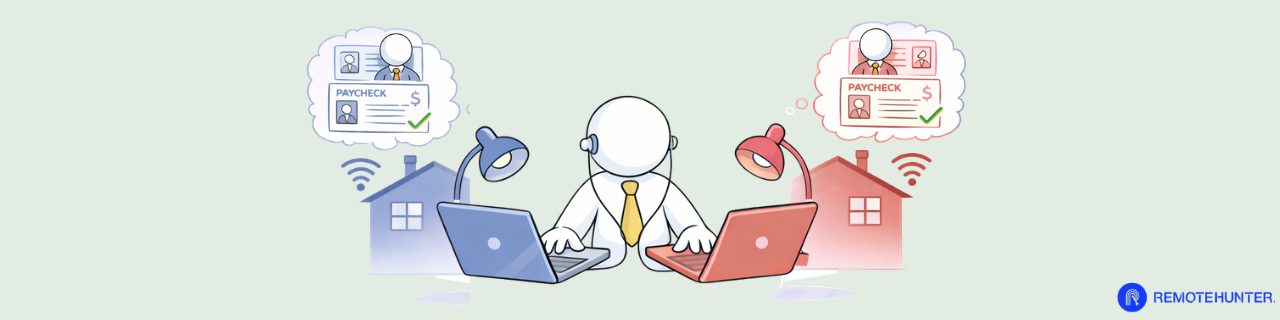

The concept of the “hustler” isn’t new. For decades, people have balanced day jobs with night shifts or weekend gig work to get ahead. But around 2021, a fundamental shift occurred. As the world moved into home offices, the traditional “hours for dollars” contract began to crumble. Workers realized that if they could finish their daily tasks in three hours, the remaining five hours belonged to them—not the company. This gave birth to the Over-Employment (OE) movement: the calculated practice of holding two or more full-time, salaried remote roles simultaneously.
Recent 2025-2026 industry surveys suggest that nearly 5% to 10% of high-skill remote workers are “multi-jobbing” in some capacity. This isn’t just about greed; for many, it’s a hedge against a volatile economy and the “loyalty tax” companies pay to long-term employees.
The debate has drawn a line in the sand:
- The Corporate View: Many executives view OE as “Time Theft,” arguing that a full-time salary implies exclusive access to a worker’s focus and availability. They see it as a breach of trust and a conflict of interest.
- The Employee View: Proponents argue that if they meet all their KPIs and deliver high-quality output, it shouldn’t matter if it takes them 40 hours or 4. They view themselves as “Output-Based” professionals who are simply refusing to be “punished” for being efficient.
The “Efficiency Paradox” is the engine that drives the Over-Employment movement. In a traditional office, the reward for finishing your work early was almost always more work. If you finished your spreadsheet at 2:00 PM, your manager would simply drop another one on your desk. Remote work killed that dynamic.
High-performing remote workers have mastered what we call the 10x Efficiency Loop. They realize that if they can accomplish in 10 hours what a “standard” employee does in 40, they’ve created a vacuum. Instead of filling that void with Netflix, the Over-Employed fill it with “Job 2” (J2). They aren’t necessarily working twice as hard; they are working twice as efficiently. But in 2026, reaching this level of speed isn’t just about discipline—it’s about the tools being used to bridge the gap.
If the home office was the foundation of Over-Employment, Generative AI is the rocket fuel. In 2026, the barrier to entry for holding two jobs has plummeted because AI now handles the “administrative tax” of being an employee.
Studies show that nearly 22% of all deep work time is now assisted by AI tools like ChatGPT, Claude, and specialized agents. For an OE practitioner, this means:
- Meeting Mastery: AI assistants transcribe and summarize J1’s meeting in real-time while the worker is actively contributing to J2’s brainstorm.
- First-Draft Speed: Coding, copywriting, and data analysis that used to take four hours now take forty minutes with a human-in-the-loop AI workflow.
- Communication Automation: Using AI to draft Slack updates and emails ensures a consistent “presence” in both companies without the worker having to be glued to two keyboards at once.
AI hasn’t just made workers faster; it has decoupled “output” from “effort.” When a worker can produce 40 hours of value in 15 hours using AI, the moral question shifts: Is it “cheating” to use that extra time for a second salary, or is it just smart portfolio management?
Living a double life requires more than just speed; it requires elite-level “Calendar Tetris.” The biggest hurdle for the Over-Employed isn’t the workload—it’s the Meeting Conflict. To keep two worlds from colliding, practitioners use a specific, high-stakes playbook:
- The Synchronized Calendar: Practitioners use tools to auto-block time on J1’s calendar whenever a meeting is booked on J2’s. These blocks are usually disguised under vague, professional titles like “Deep Work,” “Project Focus,” or “Client Research.”
- The Hardware Divide: The cardinal rule of OE is never mix machines. Pro-level multi-jobbers use two separate laptops, often side-by-side on a KVM switch or separate desks. This eliminates the catastrophic risk of a “wrong-window” Slack message or an accidental screen-share leak.
- The “Loom” Pivot: The goal is to minimize “live” time. OE-savvy workers aggressively push for asynchronous communication. By sending a recorded Loom video or a detailed Notion doc instead of hopping on a call, they reduce the chance of overlapping meetings.
- The LinkedIn “Ghost” Mode: To avoid being flagged, many “hibernate” their LinkedIn profiles or set them to maximum privacy, preventing “congratulations on the new role” notifications from reaching the wrong audience.
Despite the financial allure, Over-Employment is not a “free lunch.” It is a high-stakes gamble that requires a stomach for risk. In 2026, the consequences of getting caught have shifted from a simple “slap on the wrist” to potential career blacklisting.
- The Legal Trap: Many modern employment contracts now include specific “Exclusivity of Service” or “Non-Moonlighting” clauses. HR departments are becoming more sophisticated, using background check services that monitor active tax contributions. Getting caught can lead to immediate termination for cause.
- The Burnout Factor: Even if AI automates 60% of your tasks, the mental overhead of maintaining two identities is taxing. The constant fear of a “hot mic” or a sudden “emergency” meeting at both jobs simultaneously creates a baseline of hyper-vigilance.
- The Trust Gap: Ultimately, the remote work revolution is built on a foundation of trust. Critics argue that OE practitioners jeopardize the flexibility of the entire remote workforce, potentially fueling “Return to Office” (RTO) mandates.
At RemoteHunter, we believe the ultimate goal of the modern professional isn’t necessarily to hold two jobs—it’s to possess the optionality to do so. Whether you want to double your income through Over-Employment or simply reclaim twenty hours of your week for family and personal growth, the path is the same: Digital Mastery.
Being “10x” isn’t a myth; it’s a result of combining elite-level Remote Fluency with an optimized digital stack. When you master the AI-driven workflows we teach, you stop being a “task-taker” and start being a “value-generator.”
The Over-Employment movement is a symptom of a changing world. It is a direct response to a corporate culture that has historically rewarded efficiency with more work rather than more pay. In 2026, the tools to manage multiple roles are more accessible than ever, but the risks remain significant.
Ultimately, the “Shadow Career” isn’t for everyone. It requires a rare blend of technical skill, emotional resilience, and a high tolerance for risk. But regardless of where you stand on the ethics, one thing is clear: the future belongs to those who can deliver the most value in the least amount of time.